
Featured
Vietnam in 2025: A year of adjustment
From markets and money to property, infrastructure, climate and daily life, 2025 was a year in which Vietnam recalibrated rather than surged, setting a cautious but hopeful tone for 2026.
Recalibration
Vietnam entered 2025 without the drama that marked earlier post-pandemic years. There was no sudden surge, no sharp collapse, and no single defining shock. Instead, the year unfolded as one of adjustment in expectations, behavior and the pace at which both households and institutions moved.
Globally, uncertainty remained a constant backdrop. Slower growth in major economies, shifting supply chains and volatile financial conditions filtered into Vietnam in muted but persistent ways. Domestically, the sense was less of crisis than of careful positioning. Businesses focused on stability, households remained watchful, and policy signals tended toward reassurance rather than ambition.
If 2024 was about regaining momentum, 2025 was about testing durability.
Growth steady but uneven
On paper, Vietnam’s economy continued to expand in 2025. Government statistics show GDP grew by about 8%, one of the stronger performances in the region despite mounting external pressures. Exports climbed an estimated 17% to roughly $475 billion, with shipments to the United States alone exceeding $150 billion, a new high. Overall, the trade surplus with Washington widened sharply, despite tariffs.
Yet headline growth masked uneven experience. Manufacturing and export-oriented sectors led the way, supported by foreign investment and supply chain diversification. Services grew too, but spending patterns remained cautious, shaped by cost pressures and consumer restraint. For many households, the lived experience of the economy lagged behind macro figures, anchored more in job security and daily expenses than in abstract growth rates.
Growth was real, but selective.
Markets, money and confidence
Financial markets reflected this cautious mood. The VN-Index experienced bouts of volatility, but without the panic associated with systemic stress. Retail investors remained active, though sentiment was more defensive than speculative, while foreign participation ebbed and flowed largely in line with global risk appetite.
The year also brought a defining external test in the form of U.S. tariff threats and negotiations. Early fears of reciprocal tariffs of up to 46% unsettled exporters and markets. A series of government engagements with Washington, including high-level talks, ultimately resulted in tariffs of around 20% on many goods and opened discussions on a broader trade framework. Despite the duties, export values and surplus figures held up impressively, underscoring Vietnam’s export resilience and its capacity to manage external risk through engagement.
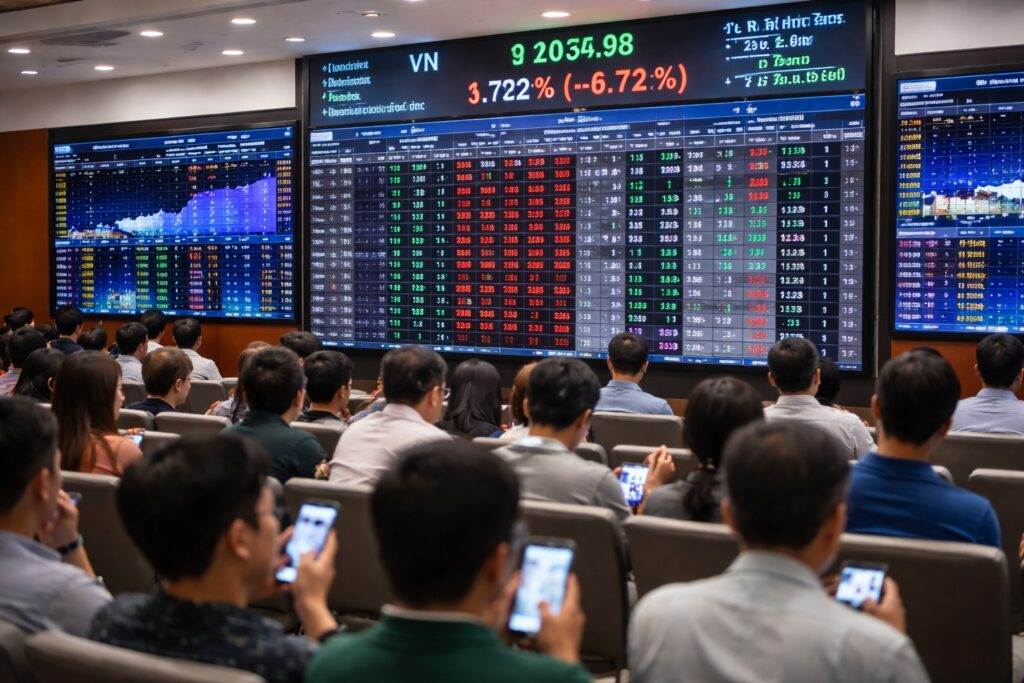
Investors watch market movements at a Vietnamese stock exchange, as volatility shaped sentiment through much of 2025.
Property prices told a quieter story.
In Ho Chi Minh City, average primary housing prices rose modestly to around $3,750 per square meter by the third quarter, up roughly 9% year over year, while in Hanoi, limited new supply and strong demand pushed prices higher still. Transaction volumes remained subdued outside prime locations as buyers waited for clearer signals and financing conditions tightened. Analysts broadly described the market as stabilizing rather than correcting sharply.
Gold shifted from quiet reassurance to standout story. While global prices rose around 20% to 30%, domestic gold prices surged far more dramatically, with SJC gold climbing to VND 150 million to 160 million per tael, equivalent to nearly $6,000, at points during the year. The widening gap between local and international prices reflected strong household demand, tight supply controls and policy constraints, turning gold into one of the most visible expressions of financial anxiety and confidence management in the Vietnamese economy.
Infrastructure progress
Infrastructure was one of the few areas in 2025 where progress felt tangible. Sections of the North–South Expressway continued to open, easing long-distance travel and improving freight efficiency, while construction momentum was maintained at Long Thanh International Airport, a project that has come to symbolize Vietnam’s long-term ambitions.
In urban centers, smaller gains mattered more. In Ho Chi Minh City, the launch of Metro Line 1 marked a milestone for public transport after years of delay. At the ports, expanded capacity at Lach Huyen improved logistics throughput, reinforcing Hai Phong’s role as a critical northern trade gateway.
Infrastructure did not transform the year, but where improvements touched daily routines, smoother journeys, faster cargo movement and incremental relief from congestion, their value was immediately felt.
Climate and environment
Environmental strain in 2025 was defined less by single disasters than by accumulation. In Hanoi, prolonged winter episodes of hazardous air quality pushed PM2.5 levels well above World Health Organization guidelines for days at a time, prompting school advisories, mask use and a renewed focus on indoor air filtration.
Heat was the other constant. Extended hot spells disrupted work routines, slowed outdoor labor and drove up energy demand as households relied more heavily on air conditioning. Storms and flooding continued to test resilience in central provinces and the Mekong Delta, damaging crops and straining local infrastructure.
What changed was not severity, but normalization. Extreme conditions increasingly felt like background constraints shaping how people planned, traveled and worked. Policy responses remained incremental, but public awareness deepened. The environment was no longer a headline issue. It had become a constant presence.
Looking ahead
By the end of the year, Vietnam stood neither buoyant nor brittle. Markets were waiting, property was stabilizing, infrastructure was inching forward and environmental pressures were increasingly unavoidable. The dominant question was no longer recovery, but direction.
If 2025 was a year of adjustment, 2026 will test whether that adjustment delivers deeper confidence, structural reform and sustainable momentum. For now, Vietnam moves forward carefully, watchful, adaptive and still very much in motion.
Photo: Shutterstock




spinbet99
March 12, 2026 at 3:26 am
Yo, spinbet99 has got some major appeal! The slots are top-notch. I’ve seen people winning big on it! Give it a spin and see what happens spinbet99.
top777login
March 12, 2026 at 3:26 am
Man, top777login is pretty slick. The interface is user-friendly, and I didn’t have any issues logging in. Give it a go if you’re looking for a smooth experience top777login.
winmxncasino
March 12, 2026 at 3:26 am
Yo, winmxncasino! I threw some cash in and had some fun, you know? The layout is easy to figure out, and it didn’t take long to find games I enjoyed. Worth a shot winmxncasino.
Casino Rex Bonus ohne Einzahlung
June 16, 2026 at 7:12 am
References:
Casino Royale kostenlos stream Casino Rex Bonus ohne Einzahlung
phparkjili
August 29, 2026 at 3:13 am
I really appreciate the customer support here. They answered my query about the deposit within minutes. phparkjili
phgperyaapp
September 2, 2026 at 9:50 pm
I’ve tried a few apps lately but this one is definitely the smoothest. The interface is super easy to navigate and the payouts are quick. Highly recommend phgperyaapp for anyone looking for some real excitement.
idlogika300
September 5, 2026 at 6:17 am
This site is a hidden gem. The rewards system is very generous for new players. I am loving my time on idlogika300.